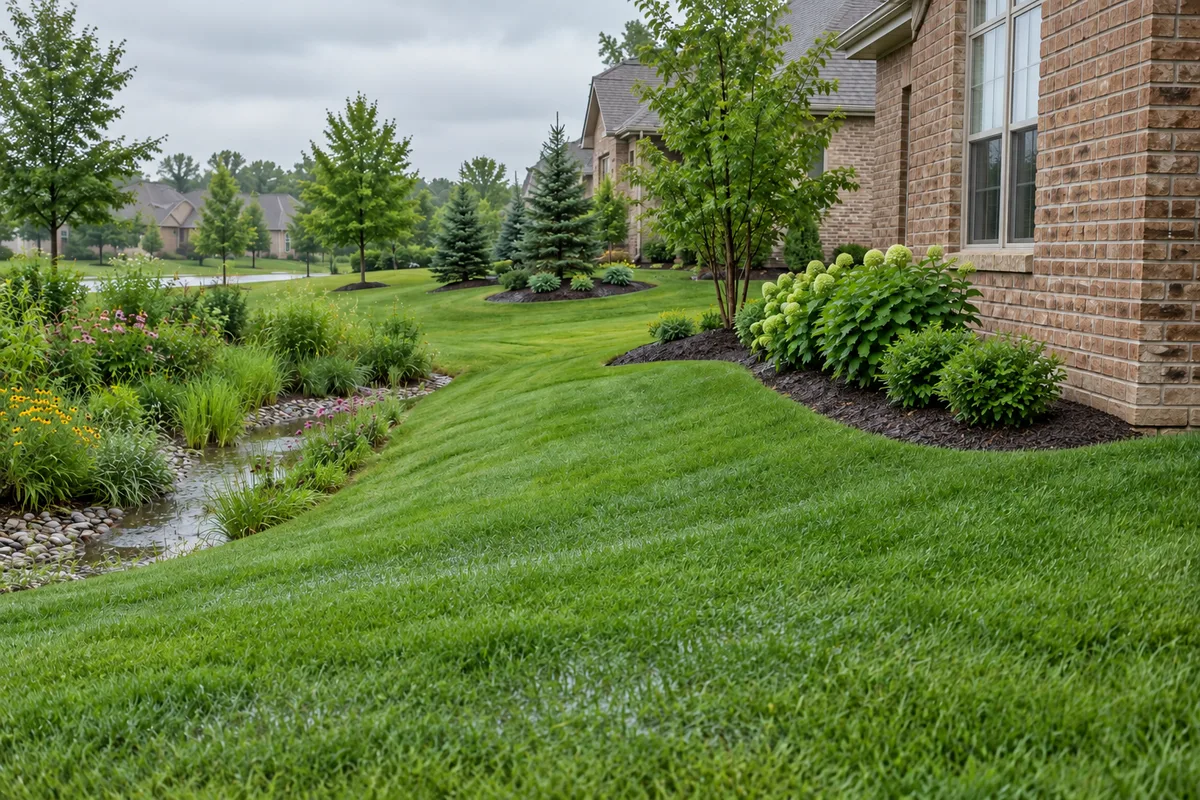
Carmel Signature Drainage frames yard grading as the controlled reshaping of surface flow, not a promise that adding soil will dry every yard. Grading can correct a low area, restore fall away from a structure, or form a shallow swale. It cannot replace a subsurface collector when groundwater is the main source, and it still needs a lawful receiving area.
Read the contours before moving soil
Mark high points, low points, and barriers
A useful surface plan identifies where runoff enters, where it ponds, and what blocks its path. Patios, walks, fence lines, planting beds, window wells, downspouts, neighboring grades, and settled backfill can all change the route.
Separate broad runoff from a single inlet problem
Water moving as a shallow sheet may respond to recontouring. Water concentrating at one depression may need a catch basin. Soil that remains wet without visible surface flow can point to a French drain.
Shape a swale without creating a ditch
Use a broad, maintainable flow path
A swale is a shallow contour that carries runoff through turf or landscaping. Width, side transitions, longitudinal fall, discharge location, and mowing or planting needs are coordinated together. A narrow groove can erode or become an obstacle without moving enough water.
Protect the receiving area
The end of the swale must release water without washing out soil, saturating a foundation, crossing an unapproved boundary, or backing up at a sidewalk. Erosion control, turf establishment, and an overflow path are part of the surface design.
Coordinate yard grading with soil and drainage structures
Do not bury utility access or drain inlets
Imported soil can cover valve boxes, cleanouts, grates, foundation details, or the intended surface outlet. Existing utilities and private lines also constrain excavation and compaction.
Combine methods only where each has a job
Grading may lead water toward a surface basin, while solid pipe carries buried downspout flow beneath the restored yard. Combining components is useful when it follows the water path, not when extra products are added without a role.
Restore graded soil for seasonal drainage
Stabilize reshaped soil and establish durable surface cover
Reshaped soil needs suitable compaction and a stable surface. Topsoil depth, seed or sod, planting beds, settlement, and construction access affect both appearance and performance. Carmel notes poorly draining local soils and seasonal high water tables, so a surface correction should not be presented as a cure for every groundwater condition.
Price yard grading by area, access, and tie-ins
Count cut and fill, equipment access, drain tie-ins, and turf
Quote drivers include the square footage being reshaped, cut-and-fill balance, imported soil, haul-off, equipment access, utilities, tree roots, inlets or pipe tie-ins, erosion control, and sod or planting restoration. Compare quotes against the same finished grades, soil handling and restoration scope.
Review yard grading against easements and regulated drains
Review regulated drains, easements, and buried facilities
Carmel Engineering says property owners maintain drainage easements on their land, but improvements within an easement or City right-of-way may require a Consent to Encroach Agreement. Regulated drains fall under the Hamilton County Surveyor. Those records should be checked before changing a surface route.
Even shallow excavation can encounter buried facilities. Indiana 811 requires advance notice, Positive Response review, and careful work around marked facilities, while private lines may require separate locating.