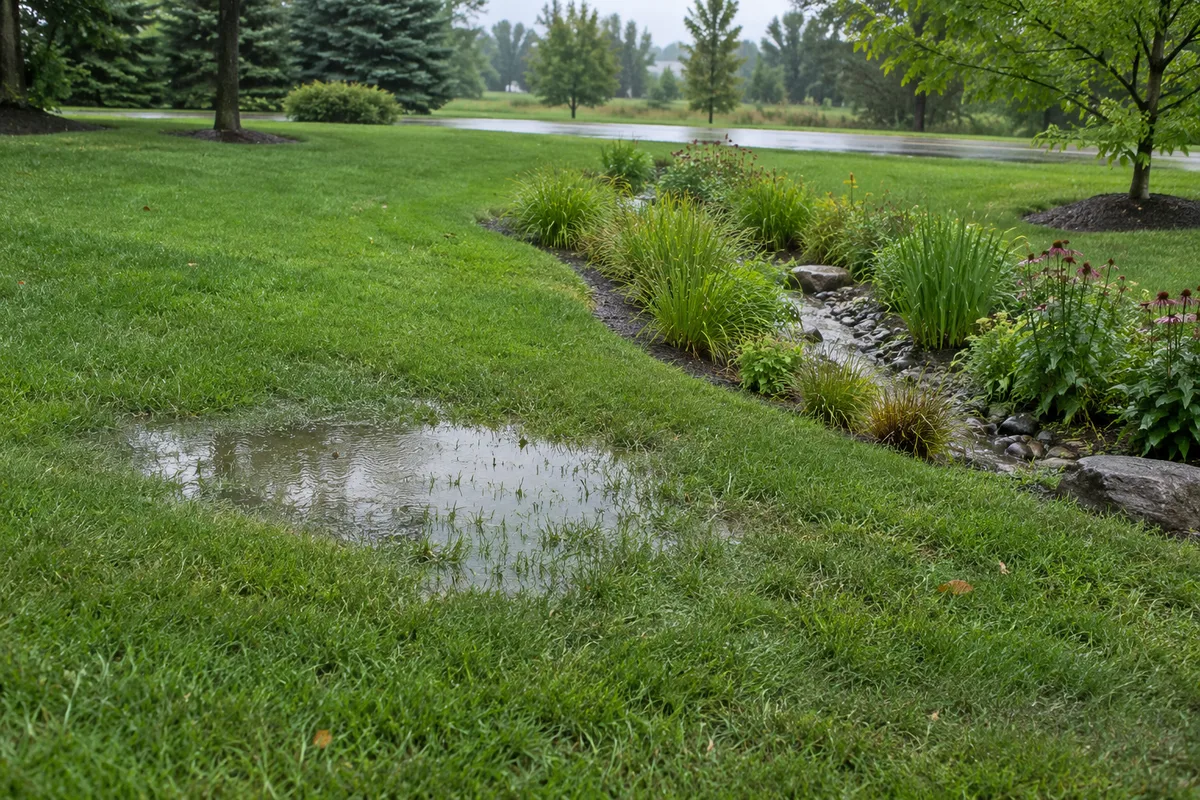
Carmel Signature Drainage treats yard drainage as a source, route, and outlet problem before assigning a product. Standing water may come from roof runoff, a depressed lawn, saturated subsurface soil, an obstructed pipe, or flow crossing the property. Each source behaves differently, so the useful plan may combine several methods.
Diagnose where the water starts and where it can finish
Observe the yard during rain
Photos and notes taken during a storm can show whether water sheets across turf, drops from a downspout, rises through saturated soil, or collects at one low point. Mark the first wet area, the direction of movement, and how long the surface remains soft afterward.
Confirm a lawful release point
Collection alone does not solve drainage. The system needs enough elevation and capacity to convey, retain, infiltrate, or release the water without shifting the problem to a foundation, sidewalk, road, or neighboring lot.
Decide whether an existing drain needs cleaning, repair, or redesign
Recreate the failure before opening the yard
Controlled water and storm observations can show whether an inlet accepts water, whether downstream structures fill, and whether the outlet releases. Note where water first appears, how quickly it recedes, and whether another part of the yard becomes wet. A line that once worked and then slowed suggests debris, roots, displacement, or outlet obstruction. A system that never cleared the intended area may instead have the wrong inlet elevation, inadequate fall, insufficient capacity, or a mismatched collection method.
Inspect the components that can be serviced
Remove accessible grates and inspect basin sumps for leaves, mulch, sediment, and standing water. Cleanouts, open outlets, and reachable fittings provide observation points. Roots, crushed corrugated pipe, separated adapters, sharp bends, and buried pop-up emitters can interrupt conveyance. Other system-level failures include a basin above the true low point, undersized pipe, a French drain without an outlet, or grading that moves water across a property boundary. A maintenance path should keep grates, cleanouts, and a visible release point accessible where the layout permits them.
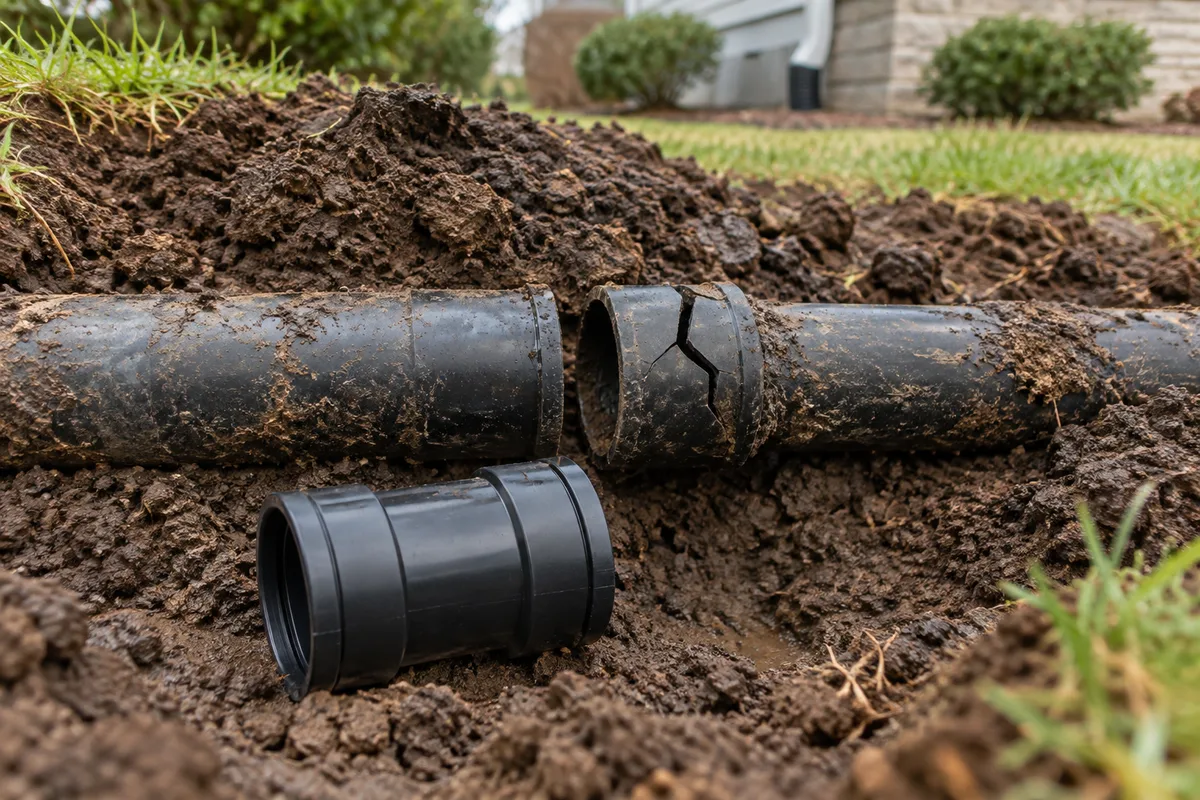
Illustrative repair components, not a completed Carmel project or a site diagnosis.
Match the correction to the proven failure
Mechanical clearing or flushing may remove loose material from suitable pipe. It cannot rebuild a collapsed wall, restore continuous fall, replace failed geotextile, or create a missing outlet. A separated fitting or short crushed section may support a targeted excavation, while repeated low spots, sediment intrusion, inaccessible connections, or an improper discharge can make a redesigned route more rational than repeated spot work.
Select collection methods by symptom
Surface water and concentrated inflow
A catch basin or channel drain collects visible runoff at a low point or hardscape edge. Buried downspouts carry roof water through solid pipe. Both depend on inlet placement, pipe size, and downstream capacity.
Saturated soil and broad sheet flow
A French drain is a subsurface interceptor, while grading and swales reshape the surface route. One should not be substituted for the other merely because both involve excavation.
Keep dry wells inside a complete drainage plan
Infiltration requires suitable ground and overflow
NDS describes a dry well as underground storage that slowly releases water into surrounding soil. That can be useful where infiltration is viable, but it is not a bottomless outlet. Storage volume, soil permeability, groundwater, maintenance access, and an overflow route matter.
Carmel soil and groundwater change the decision
Carmel Engineering states that local soils drain poorly and seasonal high water tables occur. Those conditions do not prohibit every dry well, but they make infiltration testing and outlet alternatives important before choosing one.
Include sump discharge in the exterior water-path decision
Keep the work outside the building
Where pumped water leaves a sump system, the exterior route still needs a lawful outlet, fall after discharge, and a way to reveal a downstream blockage before water returns toward the foundation. That is an exterior drainage decision, not a promise to replace a pump, alter electrical wiring, or perform interior plumbing work.
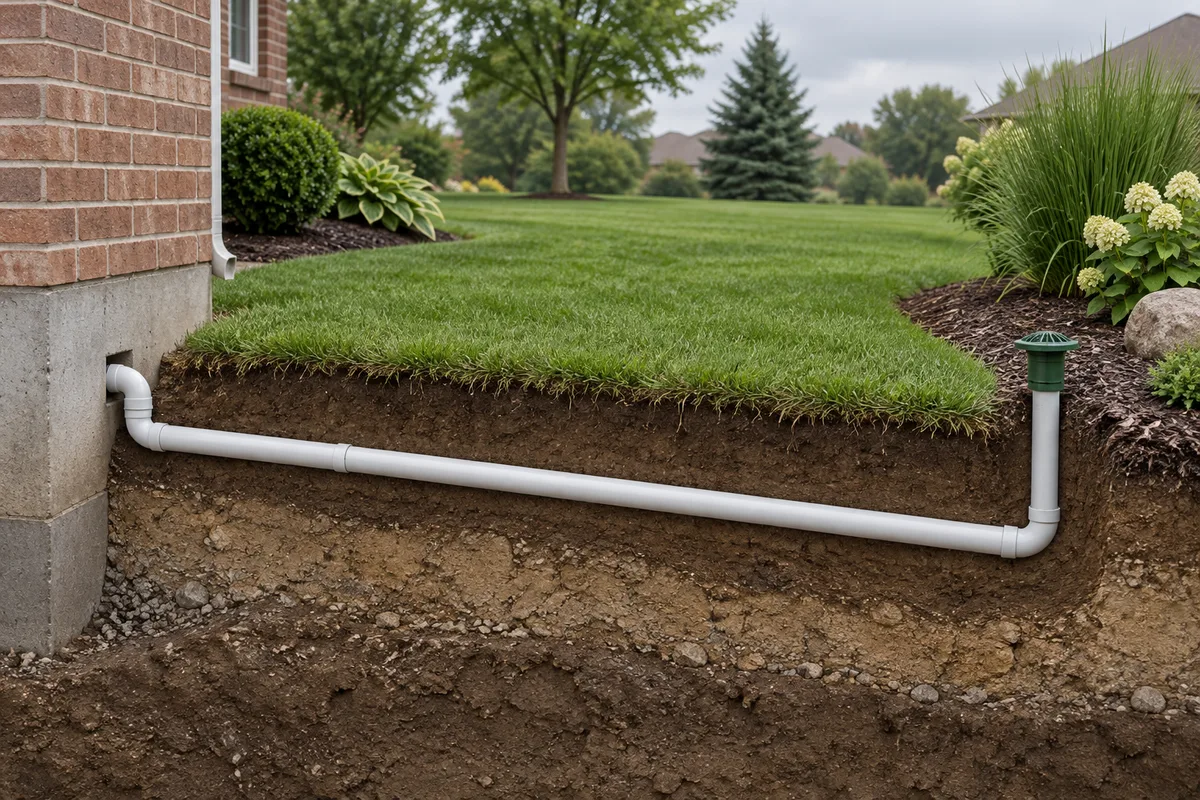
Illustrative exterior planning image, not a completed Carmel project.
Check winter and connection conditions before fixing the trench
NDS cold-weather drainage guidance recommends an air gap where an above-grade sump discharge transitions to buried downstream piping so a frozen downstream line has a visible relief path. That is manufacturer guidance for exterior drainage components, not a municipal rule or electrical instruction. Carmel’s Utilities redirection program distinguishes a sanitary-sewer correction from an approved exterior discharge path; parcel-specific outlet and qualified-trade questions still need confirmation before a route is installed. A City storm-system connection is not the default outlet; review its conditional approval steps with the other route constraints below.
Build the quote around the whole water path
Count collection, conveyance, infiltration, and restoration
Site-specific cost drivers include diagnosis and flow testing, blockage type, survey or elevation work, excavation access, pipe material and depth, trench length, basin count, dry-well storage, soil disposal, utilities, hardscape crossings, outlet correction, and sod or planting restoration. Compare proposals against the same diagnosis, receiving point and restoration scope.
Map City, County, and property-owner authority
Carmel says property owners maintain drainage easements on their property, while the City may inspect certain concerns. A regulated drain is under Hamilton County Surveyor jurisdiction. A private improvement within an easement or right-of-way may need a Consent to Encroach Agreement. Carmel Engineering requires owner plan review, a bonded contractor for the connection, and a City inspector present when a private drain connects to a City storm structure. These constraints should be mapped before the final system route is chosen.
Repair excavation still requires utility-location planning. Indiana 811 describes advance notice and Positive Response review, while owner-maintained private lines can require separate locating. A repair that changes a City storm connection, easement crossing, right-of-way route, or regulated-drain relationship needs the same authority review as a new route.