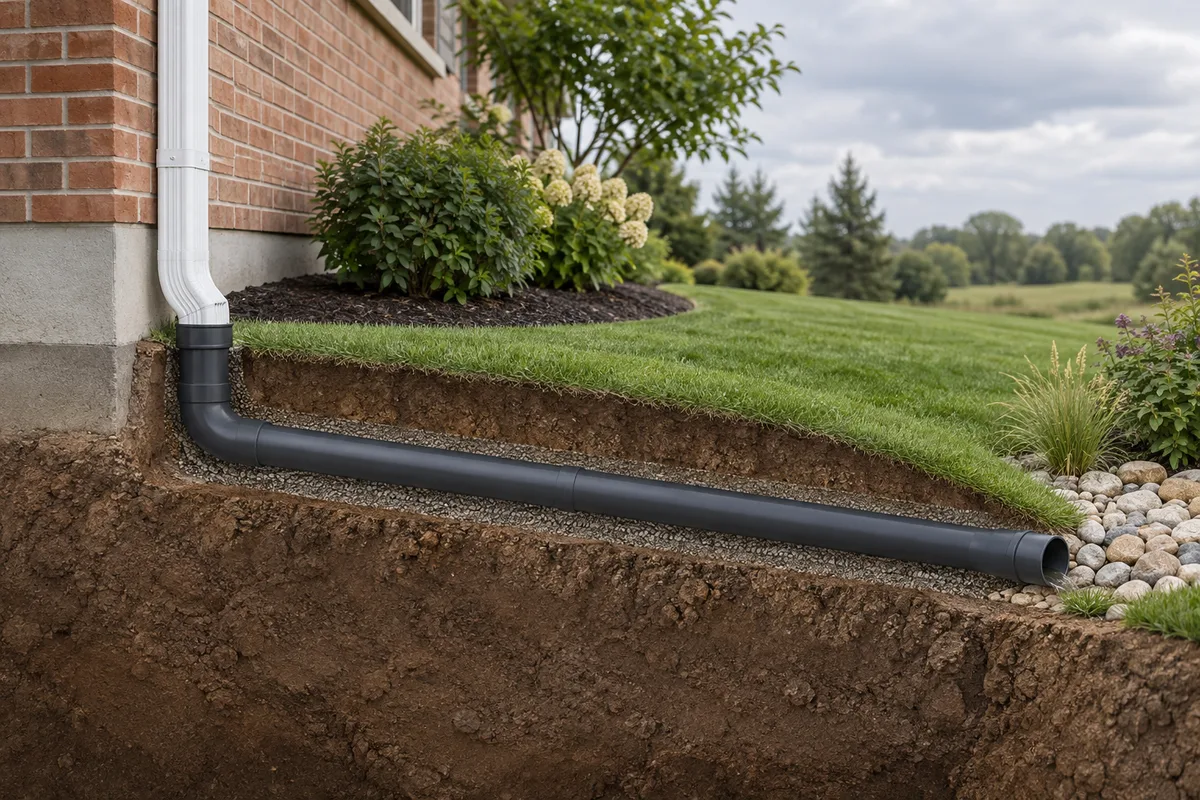
Carmel Signature Drainage separates buried downspout drainage from a French drain because roof runoff arrives as a concentrated flow. The buried route should use solid conveyance pipe, maintain fall to a serviceable outlet, and provide a way to inspect or clear debris. Perforated pipe is intended to collect surrounding subsurface water, not carry roof water through the yard.
Choose a downspout inlet with serviceable overflow
Compare an open basin with a sealed adapter
An open basin beneath the elbow can collect roof water while allowing visible overflow if the downstream system is blocked. A sealed adapter is more compact, but its layout needs deliberate overflow and service access so a frozen or clogged pipe does not push water back against the foundation.
Keep leaves and shingle grit manageable
Roof debris can settle in a basin sump, catch at a fitting, or reach the outlet. Removable grates, cleanouts, sweeping bends, and reachable discharge points make maintenance more practical than a fully buried route with no access.
Carry water in solid pipe
Maintain fall from inlet to outlet
The downstream outlet must sit below the inlet. NDS’s low-capacity downspout instructions specify at least 1 percent slope away from the house for that product layout and require its pop-up emitter to be lower than the entry point. That is manufacturer guidance for a defined assembly, not a blanket Carmel code rule.
Match material and fittings to the route
PVC and corrugated drainage pipe have different connection, stiffness, and cleanout characteristics. Pipe diameter, bends, transitions, downspout area, rainfall intensity, route length, and outlet capacity all affect the layout.
Choose an outlet that can accept roof runoff
Surface release, dry well, or approved structure
NDS describes low-capacity systems that convey to a safe downstream release and higher-capacity concepts that use storage or infiltration. A dry well belongs within the broader yard drainage plan because soil saturation, storage volume, and overflow determine whether it fits.
Do not assume the curb or storm sewer is available
An outlet can cross an easement, regulated drain, right-of-way, or City storm structure. Each condition changes the approval path and may change the route entirely.
Prevent freeze and backup failures
Preserve a visible overflow when buried pipe freezes
Low spots can hold water between storms. A blocked pop-up emitter, crushed pipe, separated fitting, tree root, or outlet buried by mulch can reduce flow. A visible overflow path near the inlet and an accessible downstream release help reveal trouble before water returns to the wall.
Price excavation, access, and restoration
Count roof area, trench access, cleanouts, and outlet work
Quote drivers include the number of downspouts, roof area, pipe size, route length, trench depth, utilities, hardscape crossings, dry-well or outlet work, cleanouts, and landscape restoration. Compare installed quotes that include the discharge point and restoration, not pipe alone.
Complete local checks before excavation
Obtain utility locates and storm-connection review
Indiana 811 requires a locate request at least two full working days before excavation and a Positive Response check. Private or non-member lines may need separate locating.
For a City storm connection, Carmel Engineering requires the owner to submit a plan before work, a bonded contractor to make the connection, and a City inspector to be present. A right-of-way or easement route can require additional permission.