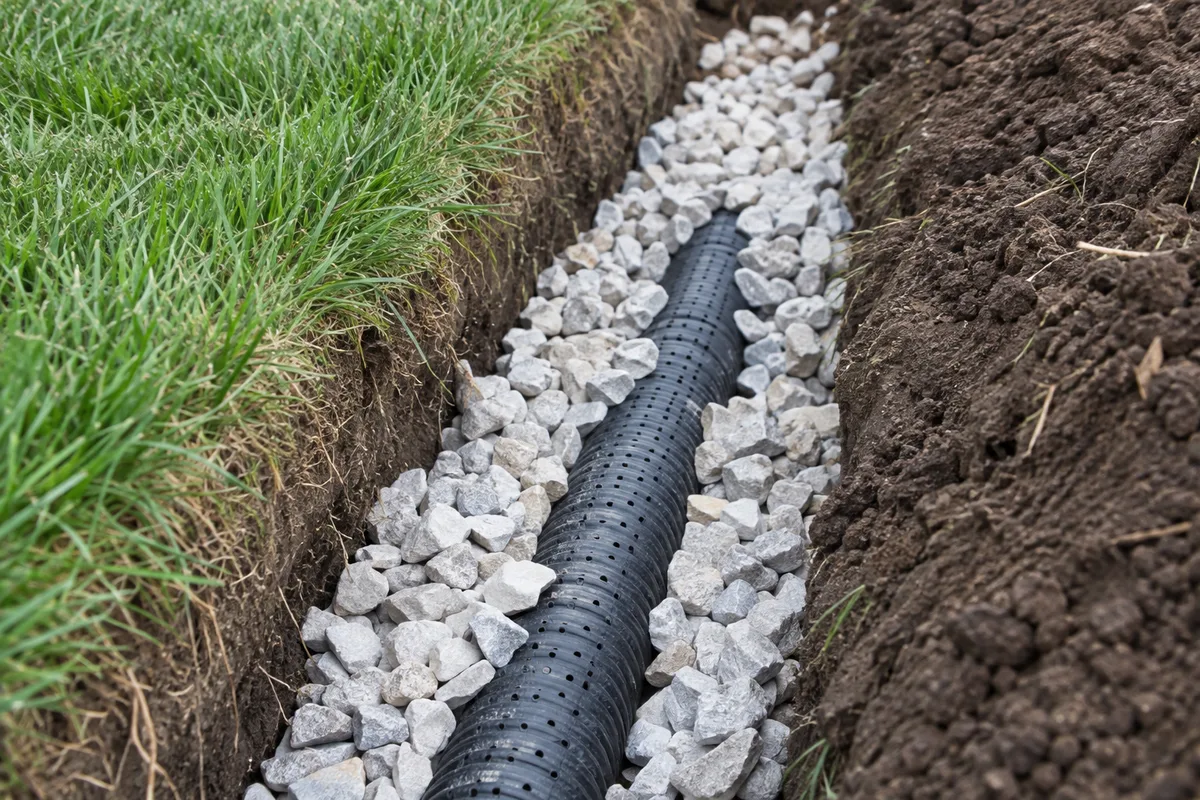
Carmel Signature Drainage explains French drain installation as a subsurface-water decision, not a default answer for every puddle. A French drain is most useful when water is moving through saturated soil and can be intercepted along a defined trench with a workable outlet. Surface runoff, roof water, and a sunken lawn can call for different methods.
Match the French drain to the water path
Subsurface saturation versus surface pooling
Spongy soil along a slope or foundation can indicate subsurface water moving laterally. A perforated collector can intercept that movement. Water gathering at one visible low point may instead need a catch basin, while shallow sheet flow can point to yard grading.
Find the outlet before setting the trench
The route needs continuous fall to an outlet that can accept the flow. Outlet elevation, property boundaries, existing storm structures, and overflow behavior are design inputs. A trench that collects water but cannot release it becomes storage rather than drainage.
Build a subsurface collector, not a buried ditch
Perforated pipe, washed stone, and filter separation
A traditional assembly uses perforated pipe, washed aggregate, and geotextile or filter fabric. The aggregate creates void space around the pipe, while fabric helps separate surrounding soil from the stone. NDS also documents gravel-free French drain products, but those product details should not be mixed with a traditional stone section without checking the selected system.
Keep roof runoff in solid conveyance pipe
Downspouts deliver concentrated water. Routing that flow through solid buried downspout pipe avoids intentionally releasing roof water along a perforated French drain. A combined plan may meet at a downstream structure when pipe capacity and the outlet have been evaluated.
Avoid the failure modes that bring wet ground back
Silt, crushed pipe, and reverse fall
Missing separation fabric can allow fine soil into the aggregate. Poor bedding or shallow load exposure can deform pipe. A high spot, reverse fall, or blocked outlet can leave water sitting inside the system even when the inlet trench looks correct.
Soil permeability limits collection at the trench
The City of Carmel says local soils drain poorly and seasonal high water tables occur. That context makes trench placement and soil permeability important. A French drain cannot collect water faster than the surrounding soil can deliver it.
Price the route and restoration, not a generic trench length
Count trench depth, materials, outlet work, and surface repair
Quote drivers include trench length and depth, access for excavation, utility conflicts, roots, spoil removal, pipe and aggregate selection, outlet work, and lawn or bed restoration. Compare an installed scope rather than a pipe-only price, keeping outlet work and restoration explicit.
Clear Carmel excavation and outlet constraints
Locate utilities and confirm easement authority before digging
Before digging, Indiana 811 requires advance notice and a Positive Response check. Its public guidance also distinguishes member utility markings from non-member or private lines and defines a tolerance zone around marked facilities.
If the planned outlet touches a City storm structure, right-of-way, drainage easement, or regulated drain, the route needs authority review. Carmel Engineering identifies plan review and inspection requirements for private storm connections, while regulated drains fall under the Hamilton County Surveyor. Those checks belong in the design before trenching starts.