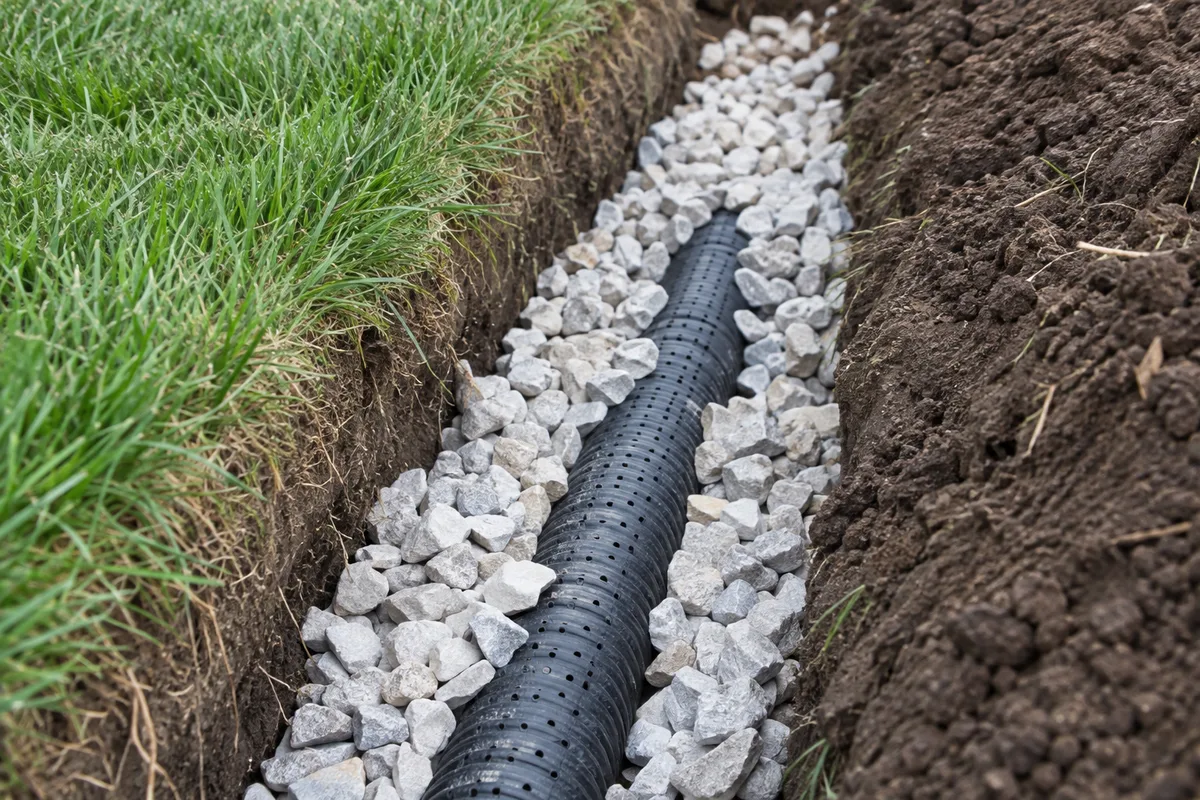
Carmel Signature Drainage starts drainage planning with the receiving system, not with a pipe purchase. A perforated collector may intercept water in the soil, while solid pipe carries concentrated roof runoff. Neither choice answers the more important question: where can that water safely and lawfully leave the route?
Name the drainage destination before choosing the collector
Separate conveyance from infiltration
A gravity outlet releases water farther along a verified route. A dry well stores water temporarily and relies on infiltration into surrounding soil. They are not interchangeable. A storage system needs suitable ground conditions, usable capacity and an overflow plan; it should not be selected merely because a gravity route is awkward.
Yard drainage planning can compare these options with surface grading and catch basins. The NDS drainage component guide illustrates collection, pipe, storage and release components. Its product examples do not establish permission to connect to public infrastructure.
Identify the receiving feature and its owner
Is the proposed destination private lawn, an open swale, a subdivision pond, a public storm structure or a regulated drain? Record that answer explicitly. A feature on a map or beside the property is not automatically an available connection. Avoid a plan that simply pushes the same water toward a neighboring foundation or blocks an existing overland route.
Compare drain elevations and maintenance access
Check the complete fall, not the apparent lawn slope
An inlet can sit below the lawn but still be too low for the intended outlet. The assessment should compare the inlet, pipe route and receiving elevation, including turns and changes in grade. A French drain with a high outlet can hold water even when the trench and aggregate look substantial.
Keep the discharge and debris points reachable
Leaves, sediment and soil can obstruct an inlet, cleanout or pop-up emitter. Plan access for inspection and maintenance instead of burying every component under planting or new hardscape. Buried downspout drainage also needs an arrangement that can be checked when roof runoff backs up.
Ask the correct Carmel drainage authority
Distinguish City structures from regulated drains
Carmel Engineering’s FAQ explains review and inspection for private storm connections and directs regulated-drain questions to the Hamilton County Surveyor. The County’s drainage permit guidance separately addresses regulated-drain crossings, outlets and easement work. Determine the parcel’s actual situation; do not assume one procedure covers every yard.
Review easements before drawing the route
Compare the proposal with the plat, recorded easements and right-of-way. Obtain the relevant authority’s confirmation before designing around public corridors. A visible clear strip is not proof that excavation or a private drain is permitted there.
Prepare the drainage assessment record
Gather observations and underground information
Photograph the start, low point and destination during rain, from a safe position. Note whether water arrives from the roof, crosses the surface or persists in saturated soil. Keep existing drain records, plats and restoration preferences with those observations. Before excavation, follow Indiana 811 guidance and account separately for private utilities.
Request a scope, not a guaranteed trench length
A useful proposal describes the water source, elevations, receiving system, collection method, conveyance, overflow, maintenance points and restoration. If surface contours are the main issue, compare yard grading before committing to subsurface pipe. The contact page provides a local preview of the assessment form; no live appointment or contractor availability is promised.